Every day MID picks a molecule, simulates its NMR spectra, and asks you to work out what it is. You get the ¹H spectrum, the ¹³C spectrum and a COSY map, six attempts, and some feedback after each guess. No account is needed, so it works well as a five minute warm-up before you sit down with your own data, or as a class exercise.
This post explains what you see on the page, what the feedback means and how to use it.
The puzzle
You will find the game under Daily Challenge in the top menu. A new molecule appears every day at midnight UTC, and everyone gets the same one, so you can compare results with colleagues. The molecules come from a pool of common organic compounds, rated easy, medium or hard.
At the top of the page there are three tabs with the spectra.
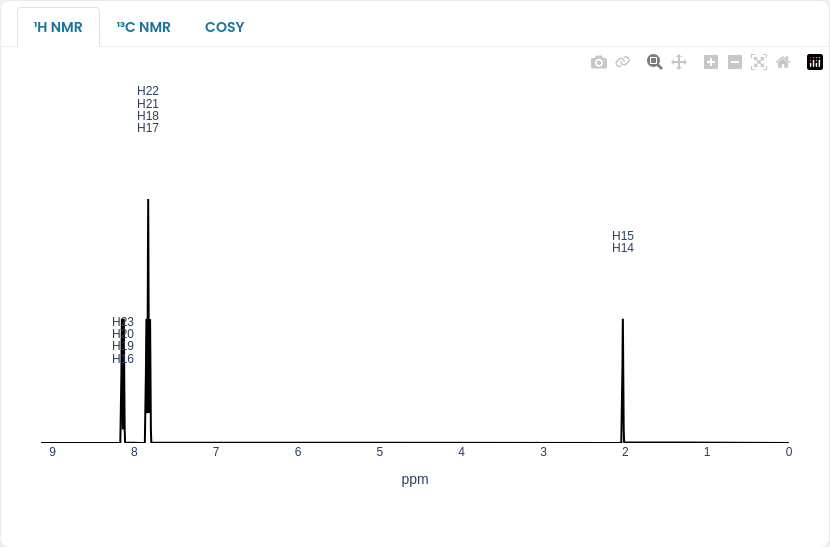
¹H NMR. Each peak is labeled with the hydrogens that produce it. That means you can count the labels on a peak to get its integral. In the example above, the signal near 8.1 ppm carries four labels, so it corresponds to four protons, and the signal near 2.0 ppm carries two. The peaks are drawn with their predicted splitting, and you can zoom into any region with the plot controls.
¹³C NMR. Count the signals here first. If the molecular formula has, say, twelve carbons but you only see six signals, the molecule has symmetry, and that rules out a lot of candidates straight away.
COSY. The COSY map shows which protons are coupled to each other, normally protons on neighboring carbons. A cross peak away from the diagonal links two signals from the ¹H spectrum. It is the quickest way to find out which fragments are connected.
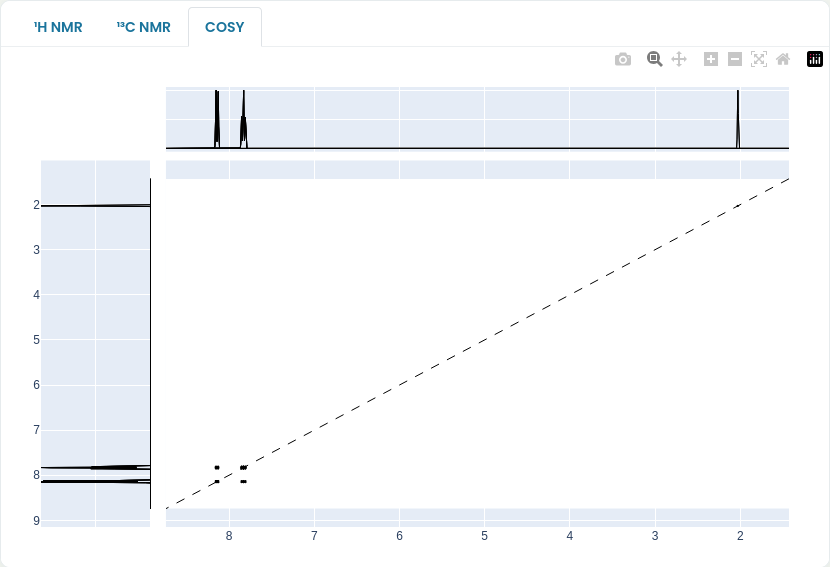
One thing to keep in mind: these spectra are predicted by MID, not measured. The overall picture (how many signals, which region they fall in, how many protons each one has, what couples to what) is what you should rely on. Exact chemical shifts can differ from literature values you may remember for the same compound, so don't rule out a candidate just because one shift is a few tenths of a ppm away from a table value.
Making a guess
Below the spectra there is a structure editor. Draw your candidate, or paste a SMILES string into the editor, and press Submit guess. Stereochemistry is ignored, so you do not need to worry about drawing the right enantiomer.
After each guess the page tells you three things:
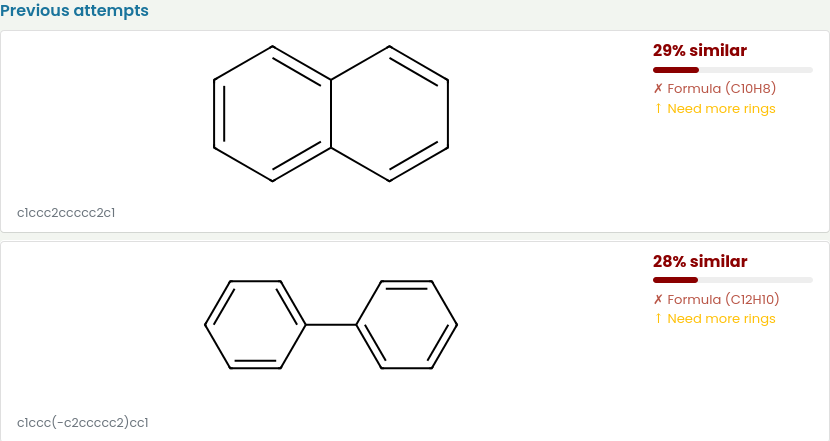
- Similarity. A percentage that measures how structurally similar your guess is to the answer, based on molecular fingerprints. It rewards sharing the same small fragments, such as the same substituents and the same kinds of bonds, rather than the same overall shape. Two molecules with the same skeleton but different functional groups can score lower than you would expect, and that is useful information in itself.
- Formula. A tick if your guess has the right molecular formula. If not, the page shows the formula of what you drew so you can compare.
- Rings. Whether you have the right number of rings, too many, or too few.
The row of colored squares at the top keeps track of your attempts: green for the correct answer, yellow for 70% similarity or more, orange for 40% or more, and black for anything lower.
A worked example
Here is how the two guesses above played out. The ¹H spectrum shows only two regions: a group of aromatic signals between 7.8 and 8.2 ppm with eight protons in total, and a single signal with two protons near 2.0 ppm. The ¹³C spectrum has just a handful of signals, so there is symmetry. Two aromatic rings seemed a reasonable starting point.
Guess 1: naphthalene. It scored 29%, the formula was wrong (C10H8) and the game said we needed more rings. So the answer has at least three rings, and naphthalene's eight aromatic protons happen to match but nothing else does.
Guess 2: biphenyl. 28%, formula wrong again (C12H10), and still not enough rings. Biphenyl has ten aromatic protons, two more than the spectrum shows, and it has no aliphatic CH2.
Put those clues together: two benzene rings, eight aromatic protons, one CH2 that shows no coupling to the aromatic protons in the COSY, and a third ring. There is really only one sensible way to join those pieces. We will leave the last step to you.
Tips for solving it faster
- Start with the counts. Number of ¹H signals and their integrals, number of ¹³C signals, and whether there is anything in the aliphatic region at all. These narrow things down more than any single shift.
- Use the formula feedback early. Your first guess does not have to be clever. A reasonable guess that tells you the formula is wrong, and in which direction, is worth a lot.
- Read the ring hint literally. "Need more rings" is often the clue that turns two separate aromatic rings into a fused or bridged system.
- Do not chase the similarity score. A jump from 30% to 60% means you found important fragments, but the last step to the exact answer often needs the spectra, not the score.
When the game ends
When you solve the puzzle, or use all six attempts, the page reveals the name and structure of the molecule together with a short hint about what makes its spectra recognisable. You can then copy your result to the clipboard. The shared text shows only the colored squares and your number of attempts, so you can post it without spoiling the answer for anyone else.
Your attempts for the day are remembered in your browser, so you can close the tab and come back later.
Give today's molecule a try at moleculeidentifier.com/nmr-game.